
We've seen rental companies lose fixtures to moisture damage after a single outdoor season. Not because they bought cheap equipment — because they bought indoor equipment and assumed the IP rating on the spec sheet told the whole story. It doesn't.
Outdoor stage lighting has a longer checklist than most buyers realize. At DMON Lighting, we manufacture IP-rated moving heads for both rental and permanent installation use — here's what actually matters when specifying them for outdoor use.
What IP Rating Actually Means
IP stands for Ingress Protection, a standard maintained by the International Electrotechnical Commission (IEC). The two digits after "IP" tell you how well a fixture resists solid particles and liquids — the first digit covers dust (0–6), the second covers water (0–9).
For outdoor stage lighting, the practical breakdown looks like this:
- IP54 — dust protected, splash resistant from any direction. Minimum for sheltered outdoor use.
- IP55 — dust protected, resistant to water jets from any direction. Standard for most outdoor event rental.
- IP65 — fully dust-tight, resistant to low-pressure water jets. Recommended for permanent outdoor installations.
What IP rating doesn't cover: operating temperature range, UV resistance, or condensation handling. These gaps are where outdoor moving head lights fail in practice — not because the housing leaked, but because the spec sheet didn't tell the whole story.
Beam vs Wash Outdoors: Different Problems
Both beam and wash moving heads are available in IP-rated versions, and most outdoor stage lighting rigs need both. But they face different challenges outside.
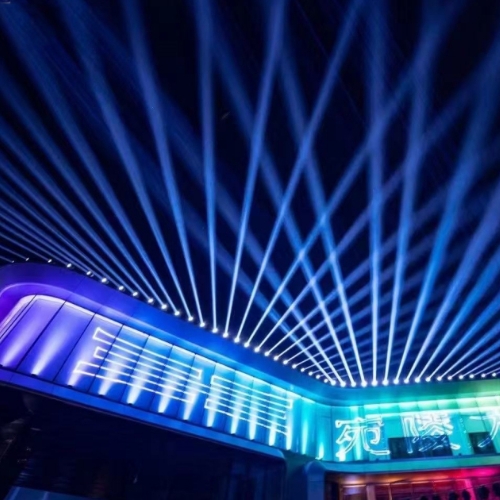
Outdoor beam moving head lights need more raw output than their indoor equivalents. Ambient light — streetlights, venue signage, sky glow — competes with your fixture in ways that don't happen in a dark club or theater. A beam moving head that reads perfectly indoors can look underwhelming on an open-air stage. Higher wattage or tighter beam angles compensate for this. It's worth testing output in the actual outdoor environment before committing to a fixture count.
Outdoor wash moving head lights face a color saturation problem. Ambient light washes out saturated colors faster than white light. RGBW fixtures hold color better in outdoor conditions than RGB-only alternatives — the white channel gives you a cleaner output base to work from. For permanent outdoor installations, this is worth factoring into the spec from day one.
Four Things the IP Rating Doesn't Tell You
1. Operating temperature range. A fixture rated 0°C to 40°C will struggle at a summer festival where ground temperature and direct sun push ambient conditions higher. Check the range against your actual event environments — not the average case.
2. Cable entry sealing. The housing may be IP65-rated, but if the cable glands aren't properly sealed, water finds a way in anyway. This is one of the most common failure points on cheaper IP-rated moving head fixtures and one of the hardest to evaluate from a spec sheet. Ask specifically, or inspect a sample unit before purchasing.
3. Condensation management. When a fixture cools rapidly after a night event — especially with a sudden temperature drop or rain — condensation forms inside the housing. Well-designed outdoor fixtures include drainage points or breather membranes that let moisture escape. Cheaper units trap it inside until it damages the electronics. This failure mode takes weeks or months to show up, by which time you're past the return window.
4. UV resistance. Housing materials degrade in high-UV environments if they're not UV stabilized. For rental use this is a minor concern. For permanent outdoor installations in high-sun climates — the Middle East, Australia, Southeast Asia — it's worth asking about specifically.
Rental Stock vs Permanent Installation: Different Specs
The right IP-rated moving head for a rental company isn't necessarily the right one for a permanent installation contractor, and it's worth being clear about which you're buying for.
For rental and touring: IP55 covers most outdoor event scenarios. The bigger concern for outdoor moving head rental stock is physical durability — how well the fixture handles repeated transport, rigging, and de-rigging without developing mechanical issues. In our experience, the fixtures that come back damaged from outdoor rentals most often have problems with pan/tilt mechanisms and cable strain relief, not with IP-rated housing failure. Specify accordingly.
For permanent outdoor installation: IP65 minimum, UV-resistant housing, and robust cable management are non-negotiable. The fixture needs to survive seasons without regular maintenance access. Total cost of ownership — lamp life, replacement part availability, manufacturer support over a 5-year horizon — matters more than upfront unit price.
DMX Control Outdoors
Long cable runs between console and fixtures increase DMX signal degradation risk. Electrically noisy outdoor environments — generators, large audio systems running nearby — make this worse. For large outdoor stage lighting setups, use proper 110-ohm DMX cable rather than XLR substitutes, terminate every chain correctly, and consider wireless DMX for runs beyond 50 meters.
The Short Version
IP rating tells you the fixture won't leak in the rain. It doesn't tell you whether it'll handle temperature extremes, condensation cycles, or UV exposure. For outdoor moving head lights — whether you're building rental stock or specifying a permanent installation — ask about all of it, not just the IP number.
If you want to know what conditions our fixtures are rated for, get in touch directly.
Frequently Asked Questions
What IP rating do I need for outdoor stage lighting with IP-rated moving head fixtures?
IP54 is the minimum for sheltered outdoor use. IP55 is the standard for professional outdoor event rental with beam moving head fixtures and general stage lighting. IP65 is recommended for permanent outdoor installations or exposed locations with higher rain risk. When in doubt, specify IP65 — the cost difference between IP55 and IP65 fixtures is usually small relative to the replacement cost of a failed unit.
Can indoor moving head lights be used outdoors?
Not reliably. Indoor fixtures aren't sealed against moisture or dust. Even light rain or persistent humidity causes electrical failures, motor damage, and corrosion. For any outdoor moving head application, always use IP-rated moving head fixtures rated IP54 minimum — and check that cable entries are sealed, not just the housing.
What is the difference between IP55 and IP65 for stage lighting?
Both provide protection against water jets from any direction (second digit: 5). The difference is dust protection: IP55 is dust-protected, IP65 is fully dust-tight. For outdoor stage lighting in sandy or high-particulate environments — desert festivals, construction sites, open farmland — IP65's full dust exclusion matters. For most standard outdoor events, IP55 is sufficient.
Do outdoor moving head lights need more power than indoor fixtures?
Not more power, but higher effective output. Ambient light in outdoor environments competes with fixture output in ways that don't happen indoors. Outdoor beam moving head lights typically need higher wattage or tighter beam angles to achieve the same visual impact as an indoor beam moving head of equivalent power. Always test output in the actual deployment environment before finalizing fixture counts.
How do I protect DMX signal in outdoor stage lighting setups?
Use 110-ohm rated DMX cable rather than XLR substitutes, terminate every DMX chain at the last fixture, and keep cable runs as short as practical. For large outdoor events with runs beyond 50 meters, wireless DMX systems eliminate signal degradation and reduce setup time significantly.
DMON Lighting has been manufacturing stage and event lighting equipment in Guangzhou, China since 2009. We supply distributors, rental companies, and venue contractors across the Middle East, Southeast Asia, Brazil, and Australia.