
The LED vs traditional lighting debate comes up in almost every equipment conversation we have with buyers. The honest answer is that neither technology has won outright — they solve different problems, and the right choice depends on what you're actually trying to do.
Here's a straightforward comparison of LED stage lighting vs discharge technology based on what we see in the field at DMON Lighting.
What "Traditional" Actually Means
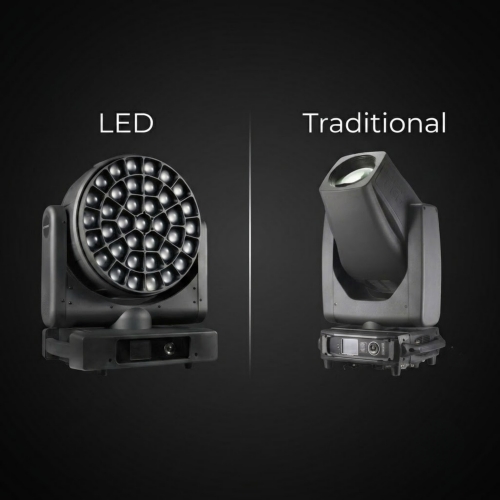
In professional stage lighting, "traditional" almost always means discharge lamp technology — fixtures running on lamps like the Philips MSD Platinum 300LL or similar high-intensity discharge sources. These are the lamps inside most professional beam moving heads and older wash and spot fixtures.
Discharge lamps work by passing an electrical arc through a gas-filled tube. The result is extremely high-intensity, coherent light from a very small source — which is why discharge beam moving heads produce sharper, more defined beam columns than most LED alternatives at comparable price points. The physics of the light source matters, not just the wattage.
Where LED Stage Lighting Wins
LED has taken over several fixture categories completely, and for good reason.
Wash fixtures. LED wash moving head lights are now the default choice for professional stage wash applications. Smooth dimming, wide color mixing range, instant on/off, low power draw, and long lamp life — every practical advantage in wash lighting points toward LED. Discharge wash fixtures still exist but are increasingly rare in new installations.
Par lights and static fixtures. LED PAR cans have almost entirely replaced traditional tungsten and halogen PAR fixtures. The energy savings alone justify the switch for any venue running fixtures for multiple hours per event.
Long-run economics. A discharge lamp costs money every time it's replaced — typically every 500–750 hours of use. An LED fixture with a rated 50,000-hour LED lifespan changes the total cost of ownership calculation significantly, especially for permanent installations or high-utilization rental stock.
Heat output. LED stage lighting fixtures produce significantly less heat than discharge alternatives. In enclosed venues, in summer conditions, or in applications where fixtures are close to performers or set pieces, this matters practically — not just in spec sheets.
Where Traditional Discharge Still Holds Its Ground
Despite LED's advantages, discharge lamp technology hasn't been replaced in every application. Two categories stand out.
High-intensity beam moving heads. The 300W discharge beam moving head light remains the standard for professional concert and event production for a specific reason: beam coherence at distance. A discharge lamp produces an extremely intense point source of light. That physical characteristic creates a tighter, sharper beam column than LED arrays at comparable prices. LED beam technology is improving, but at the mid-range price point where most rental companies and distributors buy, discharge still outperforms LED on raw beam definition and throw distance.
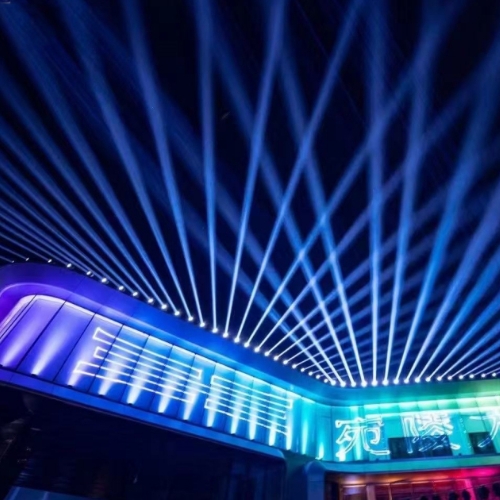
Large-venue output requirements. For applications requiring extreme output — sky beam shows, large outdoor festivals, landmark lighting — discharge lamp technology still delivers intensity that LED alternatives at comparable cost cannot match. This gap is narrowing, but it hasn't closed yet at the price points most buyers are working with.
The Hybrid Approach: What Most Professional Rigs Actually Look Like
In practice, professional stage lighting rigs don't choose between LED and traditional — they use both, for different jobs.
A typical mid-size concert or event rig in 2025 might look like this:
- LED wash moving heads for stage coverage and color — smooth dimming, good skin tones, low power draw
- Discharge beam moving heads for aerial effects — sharp beam columns, maximum throw distance
- LED spot moving head lights or profile fixtures for precision work — gobo projection, key lighting, zoom flexibility
- LED PAR lights for fill and uplighting
Each fixture type is doing what it does best. Forcing a single technology across an entire rig — whether all-LED or all-discharge — usually means compromising somewhere.
What This Means for Buyers
If you're building or expanding a rental inventory, the practical guidance is straightforward: buy LED for wash moving head lights and static fixtures, buy discharge for high-intensity beam fixtures, and revisit that second category in two to three years as LED beam technology continues to develop.
If you're specifying a permanent installation — theater, house of worship, fixed venue — LED is the right default for almost everything except applications requiring extreme beam intensity. The long lamp life, low maintenance, and energy savings compound over a fixed installation's lifespan in ways they don't for rental stock.
If you're sourcing either technology and want a straight answer on where our fixtures sit in this comparison, get in touch directly.
Frequently Asked Questions
Is LED stage lighting better than traditional stage lighting?
For wash moving head lights, PAR lights, and static applications, LED stage lighting is now the better choice in almost every practical category — lower running costs, longer lamp life, better dimming, less heat. For high-intensity beam moving heads at mid-range price points, discharge lamp technology still produces better beam coherence and throw distance. Most professional rigs use both technologies for different jobs rather than committing to one.
How long do LED stage lights last compared to discharge lamps?
LED fixtures are typically rated for 50,000 hours of LED lifespan. Discharge lamps used in beam moving heads — such as the Philips MSD Platinum 300LL — are rated for approximately 750 hours based on manufacturer specifications, and need regular replacement. For high-utilization applications, this difference has a significant impact on total cost of ownership over time.
Why do professionals still use discharge beam moving heads?
Discharge lamps produce an extremely intense, coherent point source of light that creates tighter, sharper beam columns than LED arrays at comparable prices. For concert touring, large events, and applications where beam definition at long throw distances is critical, discharge fixtures still outperform LED alternatives in the mid-range price bracket where most professional buyers operate.
Are LED moving head lights powerful enough for large stages?
For wash and spot applications on large stages, yes — high-output LED moving heads deliver sufficient brightness for most professional applications. For aerial beam effects on large stages, the answer is more nuanced: high-end LED beam lights can match discharge output, but at significantly higher cost. At mid-range price points, discharge beam moving head fixtures still have the output advantage for large-stage beam work.
What is the running cost difference between LED and traditional lighting?
LED fixtures typically use 50–70% less power than equivalent discharge lamp stage lighting fixtures — based on manufacturer-published power consumption figures across comparable fixture classes. Combined with near-zero lamp replacement costs versus regular discharge lamp replacement at $50–$150 per lamp every 500–750 hours (based on current market pricing for professional discharge lamps), LED fixtures have substantially lower running costs over time. For permanent installations and high-utilization rental stock, this difference compounds significantly over a 3–5 year period.
DMON Lighting has been manufacturing stage and event lighting equipment in Guangzhou, China since 2009. We supply distributors, rental companies, and venue contractors across the Middle East, Southeast Asia, Brazil, and Australia.